Mercury Theater — Hello Americans
The Show Welles Built for a Hemisphere
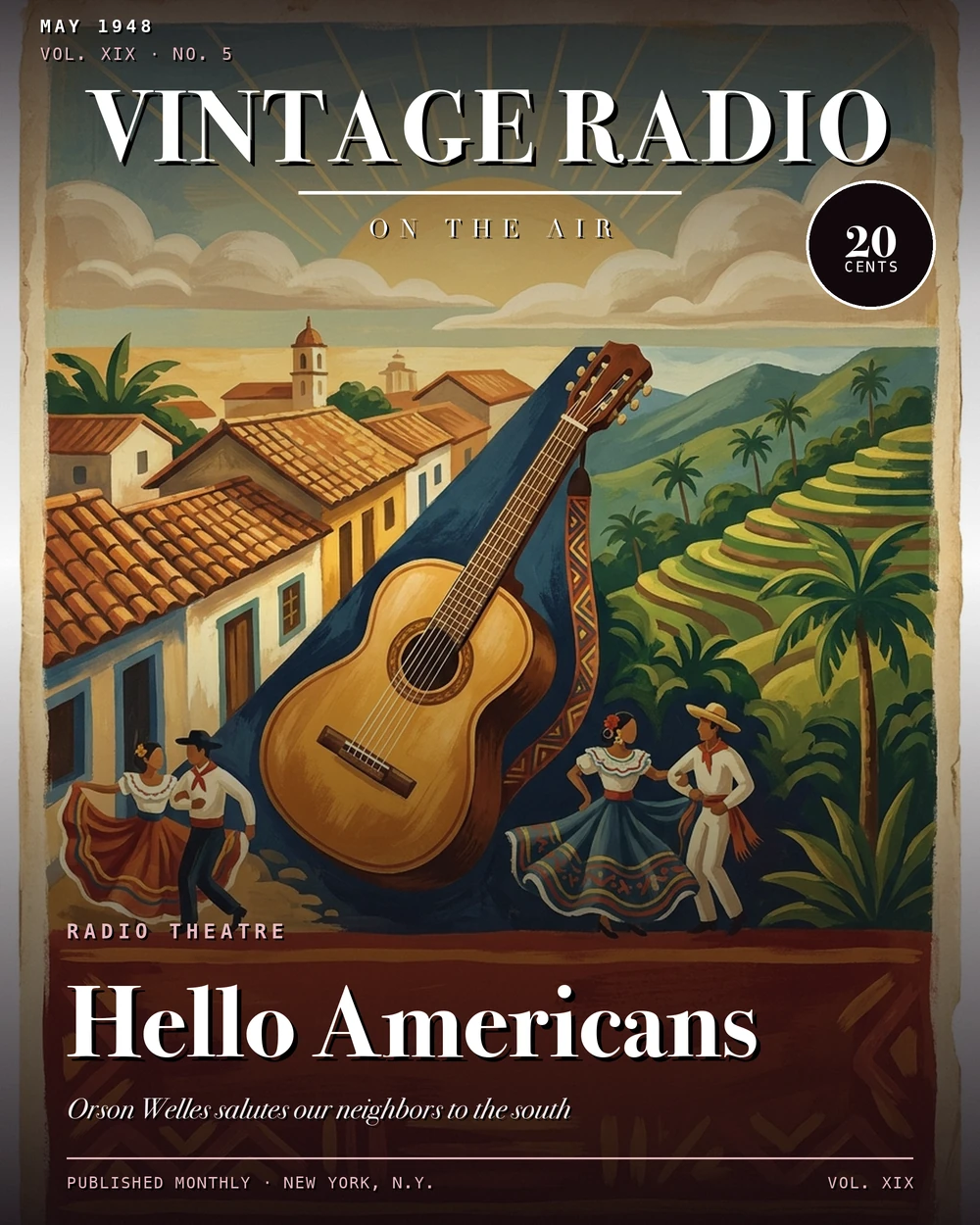
Hello Americans had a specific job to do from its first broadcast on November 15, 1942, and that job was more pointed than general wartime morale-boosting. The show existed because Germany and Italy were actively directing propaganda at Latin America, and the U.S. government needed a counter-offensive on the airwaves. The Office of the Coordinator of Inter-American Affairs — a federal agency created by President Franklin D. Roosevelt in July 1941 and headed by Nelson Rockefeller — sponsored the series specifically to build Pan-American solidarity and promote inter-American goodwill. Orson Welles hosted, directed, and produced it on CBS Radio, airing Sundays at 8 p.m. Eastern, and brought the full weight of his radio craft to the assignment.
The series ran for twelve episodes, closing on January 31, 1943 — a short run, but one with an unusually clear mandate. Where other wartime programming rallied American listeners around a general sense of national purpose, Hello Americans pointed south and said, in effect: this hemisphere is connected, and here is how and why. That narrowed focus made it different from nearly everything else on the air at the time.
Where the Material Came From
Welles didn't come to the project cold. In 1942 he had traveled to Brazil for "It's All True," an unfinished film project undertaken at the request of Rockefeller and RKO Pictures. That trip ultimately wrecked his relationship with RKO, but the research he assembled fed directly into Hello Americans. When he opened the debut broadcast with Carmen Miranda as his guest — the two of them discussing the samba, Brazil's culture, natural resources, and ethnic diversity — he was drawing on firsthand experience, not secondhand summaries.
The series title itself traced back to an even earlier moment: Welles had opened his radio play Admiral of the Ocean Sea, broadcast on Cavalcade of America on October 12, 1942, with the phrase "Hello Americans." That phrase became the name of the new series just a month later. Both the material and the framing, in other words, arrived through a chain of work rather than a single inspiration.
Welles was also running a second wartime series simultaneously. Ceiling Unlimited, sponsored by the Lockheed-Vega Corporation and dedicated to the aviation industry, aired on CBS beginning November 9, 1942 — just one week before Hello Americans launched — and ran through February 1, 1943. The two series overlapped almost entirely, which says something about the pace at which Welles operated during this period.
The Cast and the Craft
The show drew on the Mercury Theatre repertory — the same actors Welles had been working with since the Mercury's founding as an independent stage company in 1937 (its first production, a modern-dress Julius Caesar, opened at the Comedy Theatre on West 41st Street on November 11 of that year; the radio arm, Mercury Theatre on the Air, came later, debuting on CBS on July 11, 1938). For Hello Americans, that meant Agnes Moorehead, Joseph Cotten, Arthur Anderson, Dan Seymour, George Coulouris, Ray Collins, Karl Swenson, Edgar Barrier, Bud Collyer, Hans Conried, and Frank Readick all appeared in the series.
Composer and conductor Bernard Herrmann, a frequent Welles collaborator, contributed music. Lud Gluskin and his orchestra also provided musical support, stepping in as bandleader on at least two episodes when Welles was absent due to illness — on one occasion, Colombian tenor Carlos Ramirez delivered a musical recital in his place.
Biographer Simon Callow described Welles's approach on the series as "interviewing the great dead as if they were alive," mixing historical dramatization with contemporary relevance. That method is visible across the episode list: the "Andes" episode brought in Simón Bolívar and Francisco Pizarro; "Bolívar's Idea" returned to Bolívar as a figure; "The Islands" traced the history of Haiti through Toussaint-Louverture's leadership and the reign of Henri Christophe, drawing a parallel between Napoleon's influence on Haiti and Hitler's tyranny over Europe. History wasn't decoration — it was the argument.
What the Episodes Covered
The twelve surviving episodes form a geographic and cultural survey of Latin America and the broader hemisphere. "Brazil" opened the run. "Mexico," "Andes," and "The Islands" covered other regions in turn. "Ritmos de las Americas" and "Latin Music Special Program" leaned into music as a cultural bridge. "Bolívar's Idea" examined the founding vision of South American independence.
Two episodes came from outside writers. "The Bad Will Ambassador" was based on a story by Richard Brooks. "Feed the World" was written by Milton Geiger and depicted a story about global food and famine told through figures representing the Americas — a more allegorical approach than the historical dramatizations, but still rooted in the inter-American framework.
The episode list also includes "Alphabet A to C," "Alphabet C to S," "Abednego," and a "Ritmos de las Americas Special Program" — titles that gesture at a range of formats within the series, from straightforward geography and history to something closer to variety programming. Each episode ran approximately thirty minutes.
Hello Americans was part of a broader U.S. cultural initiative under the Good Neighbor Policy that included Walt Disney's films Saludos Amigos (1942) and The Three Caballeros (1944), as well as the CBS Viva América series. The radio series and the Disney films were working the same political territory through different means.
Why It Ended
The OCIAA pulled the plug at the end of January 1943, concluding that Hello Americans had not attracted a sufficient audience. The show was canceled — not because of any production failure, but because the sponsor judged the listenership too small for the investment. Twelve episodes were all it got.
The shortness of the run puts the series in an odd historical position: too brief to build the kind of audience familiarity that sustains a long-running program, but too substantial to dismiss as a minor footnote. Welles committed serious resources and talent to it, and the subject matter was genuine rather than perfunctory. Jonathan Rosenbaum documented the episodes in an annotated chronology of Welles's career in the 1992 book This Is Orson Welles, which gives a sense of how seriously the series has been taken as part of his body of work.
All twelve episodes have survived, which is more than can be said for a great deal of radio from this era. The debut "Brazil" episode also appeared as supplementary material in the Kino Classics restoration of Welles's film The Stranger (1946), released on DVD and Blu-ray in October 2013, connecting the radio work to the larger arc of his career for a new generation of viewers.